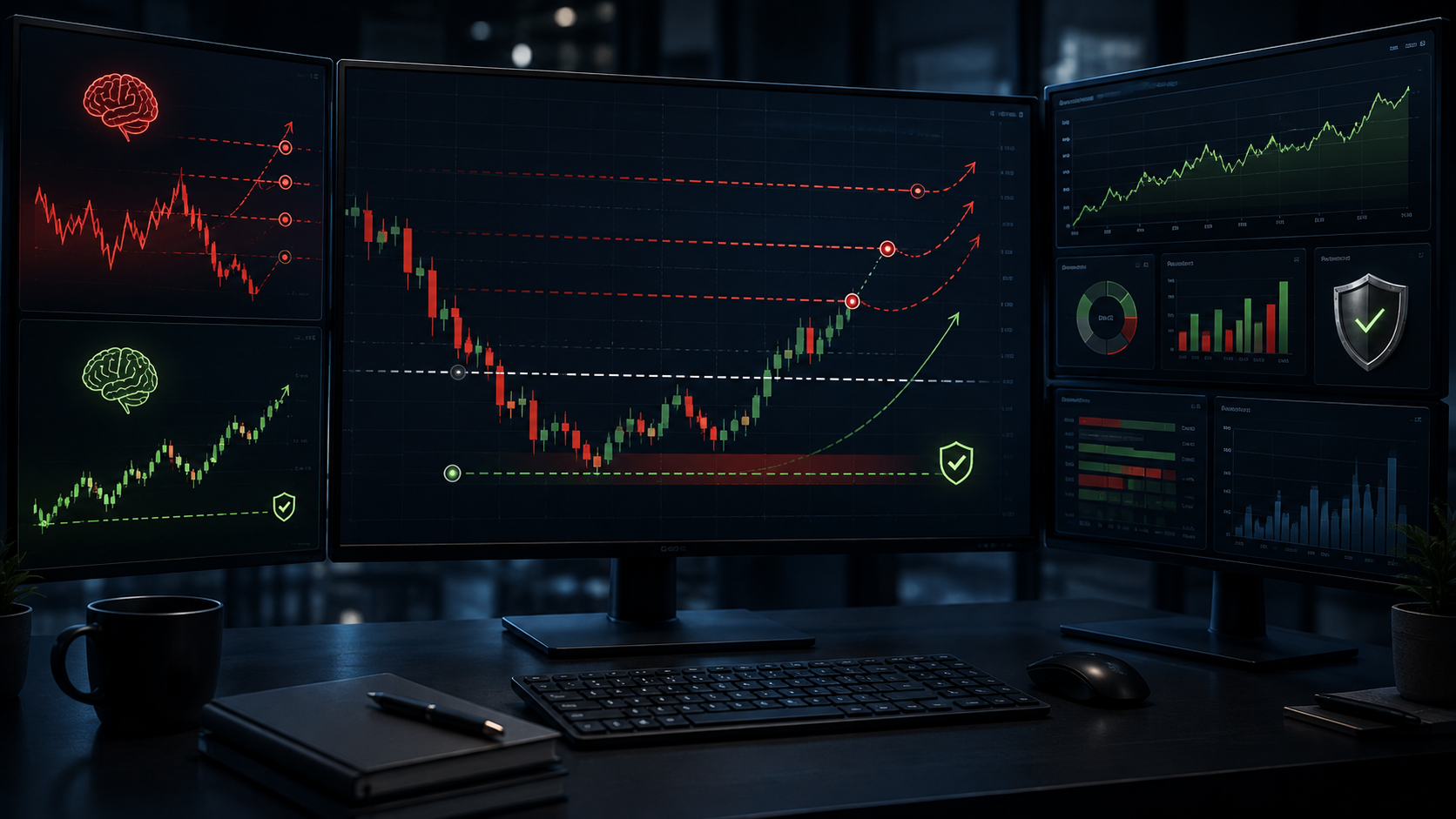
If you miss a good entry and price has already moved, the safest first response is not to trade on impulse. The original setup is no longer the same trade: the entry price, distance to a logical stop-loss, and potential reward-to-risk ratio have changed. There are only three professional options from here—wait for a planned pullback, wait for a completely new continuation setup, or skip the trade.
FOMO begins when a trader stops evaluating the market from its current price and starts trying to recover an opportunity that existed several minutes ago. Price moves, imagined unrealised profit grows, and “I missed it” turns into “I can still catch it.” That transition can turn a good market read into a poor trade.
What FOMO means in trading
FOMO stands for fear of missing out: anxiety about being excluded from a valuable experience or opportunity. The concept did not originate in financial markets. The study that developed a self-report FOMO scale linked it to concern that others are having rewarding experiences without us and to a desire to remain continually connected to what is happening.
In trading, that feeling becomes concentrated on one visible object—a rapidly rising or falling price. The trader sees the result of the move but no longer sees all the uncertainty that existed at the original entry. A completed candle always looks more obvious after it has closed.
A FOMO trade usually has one or more of these features:
entry outside the predefined zone;
an artificially tight stop-loss chosen to preserve an acceptable R;
a larger position because the move appears “certain”;
pressure to act immediately before the setup rules have been checked;
justification based on speed, candle size, or other people’s reactions;
no clear explanation of where the market idea becomes invalid after entry.
Regulators also discuss FOMO in the context of manipulation and social media. FINRA notes that a rapid price rise can intensify urgency and attract additional buyers during pump-and-dump schemes. Investor.gov warns that real-time social sentiment and buy-or-sell indicators can encourage emotional, impulsive decisions. This does not mean every fast move is manipulated. It means urgency is not evidence of quality.
The right direction can still be the wrong trade
A trader may identify direction correctly and still make a poor decision. Setup quality is more than a prediction that price will rise or fall. It includes the entry location, market structure, invalidation point, target, execution costs, and position size.
Consider a simple example. A planned long entry is at 100, the structural stop-loss is at 98, and the target is 106. Risk is 2 units and potential reward is 6 units, giving a prospective 3R trade.
If the trader notices the move only at 104 and keeps the same structural stop at 98, risk has expanded to 6 units while only 2 remain to the original target. The ratio is no longer 3R but approximately 0.33R. The directional idea has not changed; the trade mathematics has.
Sometimes a trader tries to “repair” the ratio by moving the stop to 102. If market structure does not justify that level, however, the stop is arbitrary. This is not risk reduction. It is changing the definition of risk to accommodate the desire to enter.
The important question is not, “Can price keep going?” It can. The question is, “Does a trade exist from the current price that meets my rules, has a logical invalidation point, and offers acceptable potential?”
The immediate protocol after a missed entry
During a FOMO episode, complex analysis is less useful than a short process prepared in advance. The goal is to interrupt the automatic reaction and convert “I need to catch it” into a new, independent decision.
1. Take your hand off the order button
Do not open a position at the moment you realise the entry has been missed. Cancel an unfinished market order if it was created impulsively, and let the current candle close or let the observation interval defined in your plan finish.
The pause is not a market forecast. It is execution control. A few seconds without action can be more useful than adding another indicator.
2. Mark the original setup as complete
The old entry is no longer available. Even if price later continues in the same direction, the original trade ended without your participation. This wording reduces the urge to jump into “the same trade” at any price.
From that point on, any entry must be a new setup with its own trigger, stop, target, and rationale.
3. Recalculate from the current price
Do not use the missed entry as the reference point. Mark:
the nearest structurally valid invalidation level;
a realistic target and the obstacles before it;
the distance from current price to the stop;
potential R after commissions, spread, and likely slippage;
position size that preserves the planned account risk.
If the result fails the strategy’s minimum criteria, the decision has already been made: there is no trade.
4. Choose one of three permitted scenarios
Pullback to the planned area. Price returns to the intended entry zone and again produces the confirmation required by the strategy. A stale limit order is not enough; market structure may have changed in the meantime.
A new continuation setup. After the impulse, price forms a consolidation, a new structure, or another pattern defined in the system. This is not a late version of the original entry. It is a new trade with separate statistics.
Skip the trade. Price does not return and no high-quality continuation setup appears. A missed trade is not a loss in the account. It is risk that was not accepted.
5. Reduce stimulation if the emotion remains
If you keep searching for reasons to enter, close that chart temporarily, move to a higher timeframe, or finish the session. After a strong emotional impulse, the urge to “recover the opportunity” can turn into revenge trading, particularly when the day already contains a loss.
When an entry after the move is not chasing
Not every post-impulse entry is FOMO. Some strategies deliberately trade momentum, breakouts, or continuation. The difference is not candle size or the distance price has travelled. The difference is where the decision came from.
An entry after a move can be disciplined when:
the setup was defined before the current situation;
there is an objective trigger rather than a feeling that price is escaping;
the invalidation point comes from market structure;
position size follows the stop distance and fixed risk;
the trade has independently tested statistics;
you would accept the same entry after several losses, not only when watching an impressive move.
If the rules are invented after price has already moved, it is not a new setup. It is rationalisation.
Why FOMO feels so persuasive
A missed move creates an asymmetric information picture. Potential profit is visible in each new candle, while risk has not occurred and therefore feels abstract. The mind begins counting money from a price at which no order was actually filled.
Several conditions intensify this effect:
A recent loss. The move looks like a quick way to recover what was lost.
A long period without a trade. Patience begins to feel like inactivity even when selectivity is part of the strategy.
Social-media feeds. Other people publish entries and profits but rarely show every unfilled signal, the full risk, and all losses.
Excessive focus on one instrument. Every move begins to look like the day’s only opportunity.
Vague rules. If the strategy does not state when an entry becomes too late, emotion fills the gap.
FOMO does not have to be defeated with willpower in every individual situation. It is more effective to reduce in advance the number of decisions that may be made while price is moving.
Building protection against chasing price
Define “too late” before the session
The strategy needs a boundary beyond which the original entry is no longer valid. It might be expressed as a price zone, distance to the stop, minimum R, market structure, or a volatility measure appropriate to the system. No universal number works across instruments and timeframes.
The boundary must be testable. “Do not enter too late” is a wish. “Do not enter when the distance to a logical stop exceeds the plan and the remaining target no longer provides the minimum R” is a rule.
Use alerts and prepared orders
A price alert before the entry area provides time to open the chart and validate the setup. Where appropriate, the strategy may use prepared limit or stop orders, but only with a defined position size, stop-loss, and cancellation condition. An automated order does not remove the need to check news, liquidity, and other strategy filters.
Write down the alternative scenario
Before the move, state what you will do if price leaves without filling you. For example: wait for the first correction into a new structure; trade continuation only after consolidation; stop considering the market after a defined time.
When the alternative is written down, a missed initial trigger is no longer an emergency.
Do not compensate with a larger position
Increasing size does not turn a poor entry price into a good one. It only magnifies the consequences of a decision already made under emotional pressure. Position size must follow predefined risk and the distance to a logical stop, not confidence that “this move is obvious.”
What to record in the trading journal
A missed entry is valuable process data, but only if the real cause is named. “Missed it” is not enough. Record why it happened:
no alert was set;
the market plan was prepared too late;
setup rules were unclear;
there was a technical execution problem;
the trader hesitated even though every condition was met;
the entry was correctly skipped because confirmation was insufficient.
These causes require different fixes. A technical failure calls for platform and backup-process work. An unclear setup requires sharper rules and backtesting. Hesitation may call for smaller risk, execution drills, or a checklist. A correctly skipped trade should not be “fixed” simply because price later moved in the anticipated direction.
Save screenshots of the planned entry, the moment FOMO appeared, and the end of the session. During the weekly review, measure:
how many valid setups were missed and why;
how often price was chased;
planned versus actual R;
how many trades were skipped in compliance with the plan;
whether the impulse regularly produces a continuation pattern that your system can trade.
The goal is not to ensure that an entry is never missed again. That is unrealistic. The goal is to reduce avoidable execution mistakes and stop one missed opportunity from becoming an unnecessary loss.
A missed entry is not automatically a mistake
Trade quality should not be judged only by what price did afterwards. If the required confirmation was absent, the spread was too wide, a strategy-blocked news event was approaching, or risk failed the plan, skipping the trade was the correct decision. A later move does not make that decision poor.
An execution error is different: every predefined condition was satisfied and risk was acceptable, but the order was not placed because of hesitation, poor preparation, or a technical problem. In that case, fix the process—alerts, order templates, a checklist, a backup platform procedure, or a risk level at which the plan can be executed without emotional paralysis.
This distinction protects against outcome bias. Otherwise, every move that left without you will appear to be a mistake, while every badly executed trade that happened to make money will look like a good decision.
A short checklist before any “I can still catch it” entry
Before placing the order, answer these questions:
Was this exact entry described in my plan before the move?
Where is the structurally valid invalidation point?
What is the real R from the current price, not the missed price?
Does the position size preserve my normal risk?
What is the new trigger now that the original one has finished?
Would I take this trade if I had not seen the rapid move?
What will I do if price immediately returns to the previous range?
If any of the first five questions has no clear answer, this is not an executable trading idea. It is a desire to participate in the move.
Conclusion
Missing a good entry is uncomfortable, but it is not yet a financial loss. The loss begins when a trader tries to pay for the missed opportunity with a worse price, wider risk, or an unjustifiably large position.
A professional decision starts with one recognition: the old trade is over. From the current price, only a new and fully defined setup may be traded. If it does not form, the correct action is to do nothing, protect capital, and record the event in the journal. Markets will offer other moves; discipline must be preserved until a trade appears in which your edge is genuinely present.
This material is for educational purposes and is not individual investment advice.